
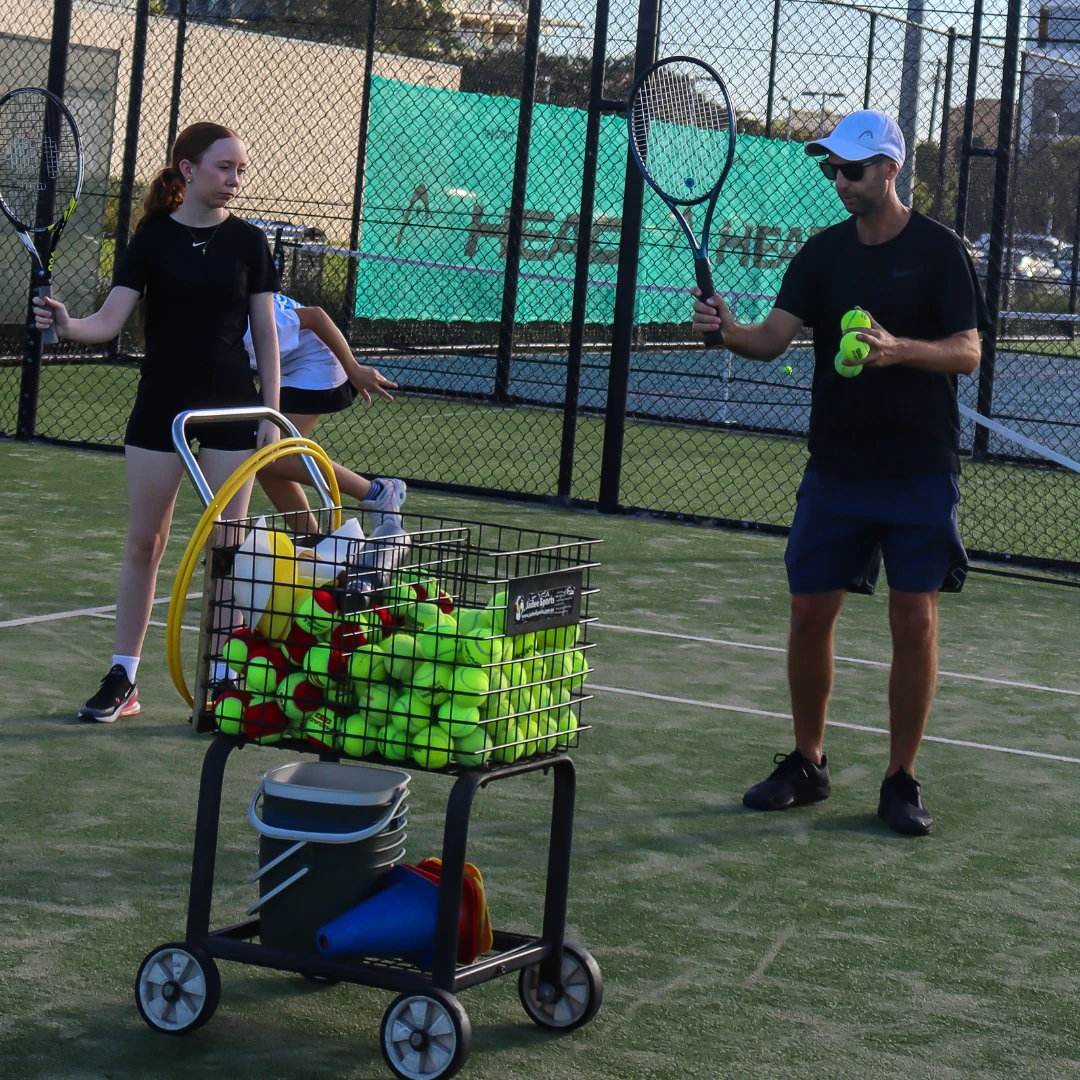
Walk onto our courts during any given week of term and you'll see three-year-olds chasing foam balls next to ten-year-olds rallying on a full court, both exactly where they should be for their age. That's really the answer to "what age should kids start tennis": it depends far more on stage than on birthday, and matching your child to the right one is what determines whether their first lesson feels like a win or a struggle. Here's how that breaks down, stage by stage, plus what the developmental research says and the readiness signs our coaches look for at North Sydney Tennis & Fitness.
Contents
The short answer: there's no single "right age," there's a right stage
Tennis Australia's Hot Shots framework, which underpins most junior programs across the country including ours, starts as early as age 3, but what a 3-year-old does on court looks nothing like what an 8-year-old does. The programs use modified courts, lower nets, foam or low-compression balls, and shorter sessions specifically so kids of different ages can succeed at their own level. So instead of asking "what age should my child start," a more useful question is "what stage matches my child right now," since that's what actually determines whether the first few lessons feel like a win or a struggle.
Ages 3 to 5: Launch Pad, building the foundation through play
At this age, tennis lessons shouldn't look like tennis lessons yet. Sessions at the Launch Pad stage are built around movement, coordination games, and short bursts of ball-and-racquet play, mixed in with plenty of play-based fun. The goal isn't technique: it's giving your child a positive first experience with a racquet in hand and building the fundamental movement skills (running, throwing, catching, striking) that every sport, not just tennis, depends on later.
If your 3 or 4-year-old has a short attention span or gets distracted mid-session, that's completely normal. It's exactly what this stage is designed for.
Ages 5 to 8: Red Ball, learning real tennis skills
By around age 5, most kids have enough coordination and focus to start learning actual tennis skills: rallying, basic scoring, and simple tactics, on a smaller court with a slower, low-compression ball. This is usually the stage where you'll see a child go from "hitting a ball" to "playing a point." Sessions are still game-based and social, but the skill progression becomes more structured.
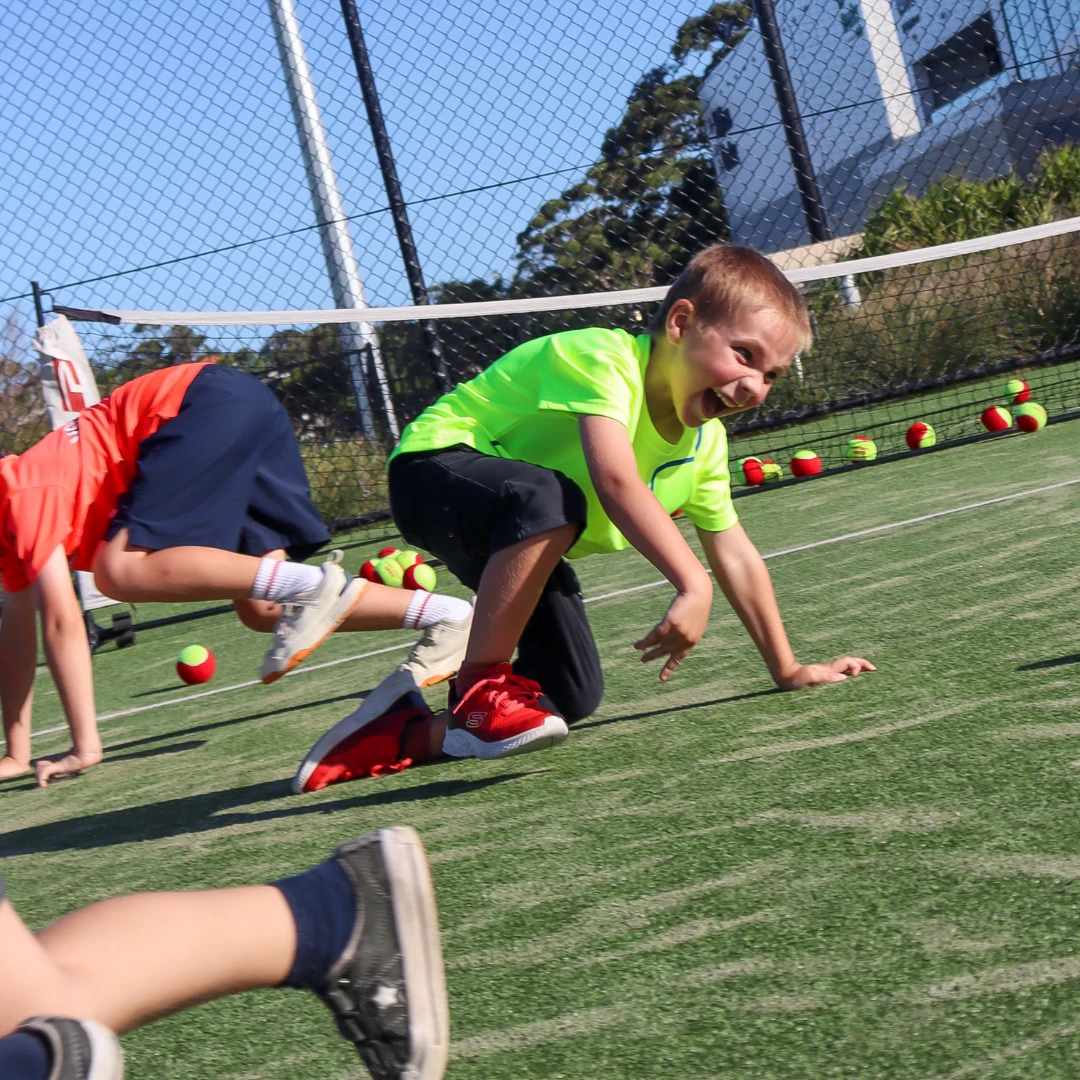
Ages 8 to 10: Orange Ball, tactics and rally skills
At this stage, kids start playing on a bigger court with a faster ball, and coaching shifts toward tactics: where to stand, how to construct a point, basic singles and doubles positioning. Kids who've come up through Launch Pad and Red Ball tend to move through this stage quickly because the foundational movement and racquet skills are already there.
Ages 10 and up: Green Ball, Yellow Ball & Squads, competitive-ready tennis
From around age 10, most kids are ready for full-court tennis with a standard yellow ball. This is also the point where the pathway splits: some kids continue with group lessons for fitness, fun, and social play, while others move into Squads or private coaching if they're aiming at club competition or a more serious pathway.
What the research actually says about sport readiness
It's worth separating "what age can my child start a tennis program" from "what age is my child ready for organised, competitive sport": they're different questions with different answers.
Peer-reviewed research on youth sport readiness suggests most children haven't developed the combination of motor skills needed for structured, competitive organised sport until around age 6, with ages 3 to 5 better suited to fundamental-movement, play-based activity rather than formal competition (sport readiness in children and youth, PMC/National Library of Medicine). That lines up closely with how Hot Shots is actually structured: Launch Pad (3 to 5) is deliberately play-first and non-competitive, while the shift toward real skill-building and light competition starts around Red Ball (5+).
Raising Children Network, the Australian Government-backed parenting resource, takes this further and argues age shouldn't be the deciding factor at all. What matters more is whether your child is enjoying themselves and showing interest, and whether you as a parent are keeping the focus on effort and fun rather than winning. Tennis Australia's own guidance on the developmental benefits of tennis similarly points to the primary-school years as the window where coordination and technical skills develop fastest, which is exactly why the Hot Shots pathway is staged the way it is, rather than being a single one-size-fits-all class.
6 signs your child is ready to start tennis
Age is a starting point, not a gate. These are the readiness signs I actually look for:
- 1.They can follow a simple two-step instruction ("run to the cone, then hit the ball") without needing it repeated several times.
- 2.They can hold a lightweight racquet with two hands without it feeling like a fight to control.
- 3.They show interest when they see other kids playing, pulling toward the court rather than away from it.
- 4.They can wait their turn for short stretches, even if not perfectly.
- 5.They've had some exposure to throwing/catching or kicking a ball in any context: backyard, PE, another sport.
- 6.They can handle roughly 30 to 45 minutes of activity without a full meltdown (younger sessions are shorter for exactly this reason).
If most of these sound like your child, they're ready to start, regardless of whether they're 3, 5, or 8.
What we've seen coaching Hot Shots (in practice)
In our years running Hot Shots, we've seen the same pattern play out again and again: the kids who stick with tennis longest aren't the ones who started earliest. They're the ones whose first few sessions were genuinely fun rather than technically "correct." A 4-year-old who spends a whole Launch Pad session giggling and chasing balls is doing exactly what they're supposed to be doing at that age, even if they don't hit a single clean forehand. The technique catches up. The enjoyment is what determines whether they're still playing at 10.
This reflects patterns we've observed across many students, not a guarantee about any individual child, since every child develops differently.
Common mistakes parents make when starting kids in tennis
- Starting a 4-year-old in a standard, full-court group class built for older kids, then concluding "they're not ready" when really the program wasn't matched to the age.
- Skipping stages to "keep up" with an older sibling or friend, which often backfires once the tactical demands outpace the child's actual skill level.
- Judging readiness by physical size rather than coordination, attention span, and interest. A tall 4-year-old isn't necessarily ready for a Red Ball class.
- Over-scheduling: one 30 to 45 minute session a week is plenty for a first year; more isn't automatically better at this age.
- Making the first lesson feel high-stakes. A low-pressure free trial removes this risk entirely, which is part of why we offer one.
Quick checklist before you book
- ✓Your child has shown some interest in tennis or ball sports generally
- ✓They can follow a short two-step instruction
- ✓You've matched them to a stage by skill and attention span, not just age
- ✓You're prepared for the first session to be more about fun than form
- ✓You've checked the current Hot Shots timetable for a class time that suits your family
Summary
There's no single correct age to start tennis, but there is a right stage, and getting that match right matters more than the number on the calendar. Most kids can start as early as 3 through play-based programs like Launch Pad, with genuine skill-building readiness emerging from around age 5, and readiness for structured, competitive-style tennis typically developing from around age 6 onward, in line with broader pediatric sport-readiness research. The best next step for most families is a low-pressure FREE TRIAL lesson matched to your child's current stage, not a decision based on age alone.
Book your FREE TRIAL Hot Shots lesson at North Sydney Tennis & Fitness and our accredited coaches will match your child to the right stage on the day. No guesswork, no pressure.
Book a Free Trial LessonFAQs
Is 3 too young to start tennis lessons?
No. Tennis Australia's Hot Shots Launch Pad stage is specifically designed for ages 3 and up, using play-based activities rather than formal technique work, so a 3-year-old can absolutely start and enjoy it.
What's the difference between Launch Pad and Red Ball?
Launch Pad (roughly ages 3 to 5) focuses on movement, coordination, and fun with a racquet in hand. Red Ball (from around age 5) introduces real rallying, basic scoring, and structured skill progression on a smaller court.
My child is 6 and has never played any sport. Are they behind?
Not at all. Six is right around the age developmental research points to for organised sport readiness generally, so a first-time 6-year-old is well within a normal starting window.
Should I start my child in group lessons or private coaching?
Most children benefit from starting in a small group: it's more social, cost-effective, and mirrors how they'll eventually play with friends. Private coaching is a great option later if they want faster technical progress or 1:1 attention.
What if my child loses interest after a few sessions?
That's common and not a sign to give up entirely. It's worth checking whether the stage matches their current attention span and skill level before assuming tennis "isn't for them."
Do I need to buy expensive equipment before starting?
No. Most junior programs, including ours, provide age-appropriate racquets and balls for trial and early sessions. You don't need to invest in gear until your child is committed to continuing.
How long are lessons for younger kids?
Sessions for the youngest age groups are typically shorter (around 30 to 45 minutes) to match attention spans, gradually increasing as kids move up through the stages.
Can older kids (10+) start tennis for the first time?
Yes. Kids who start later often progress through the early stages faster because their coordination and focus are more developed. Age isn't a barrier, just a different starting point on the pathway.
What's the best way to find out which stage suits my child?
The simplest way is to book a FREE TRIAL lesson. Our coaches will assess your child's stage on the day rather than relying on age alone.
Are there school holiday options if I don't want to commit to a term yet?
Yes. School holiday camps are a good lower-commitment way to try tennis, including options at sister SSMG facilities such as Galuwa Recreation Centre and Ryde Multisport & Racquet Centre if those locations suit your family better.
North Sydney Tennis & Fitness Coaching Team. Our coaches are accredited by Tennis Australia at Foundation and Club Professional level and deliver the Hot Shots junior development framework on-site at 37 Ridge Street, North Sydney, under Sydney Sports Management Group (SSMG), which has operated Sydney sports facilities for more than 40 years.